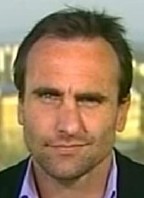
Michael
Ware
Originally
posted July 18, 2007 on the All Things Anderson
blog.
All rights reserved.
Let's be honest… we've all wondered from time to time why
anyone would be crazy enough to be a war correspondent
covering a city as dangerous as Baghdad. But if you had to
compile a recipe for how to create a good WarCo, you might
start here:
Take the smarts and tenacity of a prosecuting attorney…
Add the physical toughness and slight mental insanity of a
professional rugby player…
Mix in the dogged determination and interview skills of an
investigative journalist…
And if you're very lucky, what you end up with is Michael
Ware.
Of course, you know he's Australian; the accent and
attitude give that away straight off. Picturing him
buttoned up in a suit and tie, standing in the formal
setting of a courtroom might be more of a stretch, but that
is exactly how he planned to spend his life… well, once the
chance for rugby stardom seemed to be down the drain due to
serious injuries sustained in a traffic accident.
Just a week after being named as a reserve to the state
team Queensland Reds, his motorcycle lost an argument with
a car, and he would be off the field for the next two
years.
Meanwhile, he received his law degree from the University
of Queensland in Brisbane, and was offered a position as an
associate to fellow alum Tony Fitzgerald. That name might
not resonate with us Yanks, but Fitzgerald was at the time
the President of the Queensland Court of Appeal. Not too
shabby a start, if you want to compile an impressive resume
and get that comfy corner office some day.
But then rugby came calling again, when he was asked to
step onto the field in place of an injured player for a
Reds team touring South America. (It will surprise no-one
reading this that the position he played is considered the
most dangerous one in a sport most famous in the US for the
ubiquitous bumper sticker that reads: Give blood, Play
rugby.)
At some point after that tour, having returned to the suit
and tie, he realized how "dull as dishwater" such a career
would be and reevaluated his options.
His next stop took him to Rupert Murdoch's newspaper
stable, and again, while Murdoch's name may be best
associated with tabloids here in the States, the
Courier-Mail in Brisbane is very much a normal daily
newspaper, and Michael climbed the newsroom ladder the hard
way. His first published byline was for a humor-edged
retelling of a personal experience: having returned from a
five-week backpacking trip through Vietnam and Cambodia, he
made the mistake of petting a drug-sniffing dog at the
Brisbane airport. The dog clearly identified him as the
Alpha male, and once off-duty, came back to Michael and
dropped a chew toy at his feet. Security had a few sharp
questions regarding what exactly might be in that backpack,
sir?, and it was all somewhat amusing until the latex
gloves were snapped on.
He covered the police beat and court trials, not
surprisingly, but also did a short stint as the computer
columnist. And eventually, he started getting overseas
assignments: Jakarta, East Timor, Papau New Guinea; all in
the midst of political and social upheaval.
By the time of the 2000 Olympics, he was working for
Time and based in Sydney. After 9/11, he wheedled, cajoled,
and pleaded his way to the assignment that would shape the
rest of his career: Afghanistan. Throughout 2002 he
reported on the hunt for al-Qaeda and the Taliban, living
amongst the people in the mountains, learning to speak
enough Pashtu to bluff his way through checkpoints.
As the invasion of Iraq shaped up, he entered the country
through the Kurdish north, hooking up with US Special
Forces teams and Peshmerga militia forces to cover the
front line battles. He witnessed the death of the first
Australian journalist killed in the war, photographer Paul
Moran, and although he had never before met Moran or his
writing partner Eric Campbell, helped arrange for Campbell
to leave the country and escort his cameraman's body home.
In the summer of 2003 he relocated to Baghdad and was
soon named Time's Bureau Chief. For the next year, his
contacts within the insurgency would provide him with
access that no other journalist could match. While giving
voice to the "other side" earned him considerable
controversy, he was truly following the first rule of
warfare, per Sun Tzu: "Know Your Enemy." Throughout the
summer of 2004, he was sent videotapes showing insurgent
attacks, including the gruesome murder of four Blackwater
contractors in Fallujah by a group calling itself "Attawhid
wal Jihad" (Unity and Holy War) led by a man whose name
would soon become a household word in the West: Abu Musab
al-Zarqawi.
By September 2004 he had built up his contacts within the
insurgency to the point that he was informed when Zarqawi's
nascent "Al-Qaeda in Iraq" militia took over a section of
Haifa Street and defiantly claimed it as their own. When he
asked to be shown the area, their car was forced to a stop
by Zarqawi's men, who dragged Michael out. They forced him
to the ground beneath one of the infamous banners seen in
so many hostage tapes, and prepared to shoot him while
filming the execution on his own video camera. His life was
spared only when his Baathist guides told the gunmen that
his death would start a war between the two groups, a war
Zarqawi was not yet strong enough to win.
But while his coverage of the insurgents has been
controversial, his coverage of the military in Iraq has
been equally impressive and nearly as harrowing. Throughout
2005 and 2006, Michael's bylines read like a Foder's Guide
of Scary Places: Fallujah, Ramadi, Tal Afar, Samarra, and
of course, Baghdad itself. Footage he shot of some of those
battles has been shown on 60 Minutes and Frontline.
In May 2006, he wrote an article for an Australian magazine
that recounted the dangers journalists face every day in
Iraq, telling the deeply personal and painful story of one
of his "fixers," who was abducted and tortured for five
days by al-Qaeda interrogators in an attempt to get him to
falsely name Michael as a spy. The man was finally released
with a chilling message to deliver: "Tell Mick we're
watching him."
Michael moved to CNN in June of that year, and although he
spent his first on-air month covering the Israel/Lebanon
war, by early August he had taken up residence at the CNN
compound in Baghdad. Since then his reports have continued
to bring fresh insight and occasional controversy as the US
and its allies struggle to find closure to this war.
Michael is often asked whether he plans to cover it through
to the end; sometimes he says he hopes to. Sometimes he
doesn't answer at all.