Michael Ware
AC360 Special: Back From the Battle
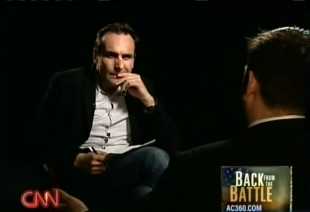
Length:
3:33
LARGE (41.4 MB) -----
SMALL (4.3 MB)
ANDERSON
COOPER: We begin with one vet CNN's Michael Ware
first met on the frontlines during the fight in
Fallujah, one of the deadliest battles of the war.
His name is David Bellavia, a former staff sergeant.
He won the Silver Star and the Bronze Star for his
service in Iraq, now an author and a veterans'
activist. David is trying to help other vets as they
come home. Take a look.
(BEGIN VIDEOTAPE)
MICHAEL WARE, CNN INTERNATIONAL CORRESPONDENT
(voice-over): After surviving this, it can be hard to
come home again.
UNIDENTIFIED MALE: Here's what we are going to do.
WARE: Staff Sergeant David Bellavia -- raising his
rifle -- knows how that feels.
STAFF SGT. DAVID BELLAVIA, U.S. ARMY (RET.): Get
back! Get back! Get back to flank.
I know when I walk down a street, I'm constantly
thinking like I'm -- you know, what's going to happen
when that window opens up. Once you know what the
hardships of war are, you're hyper-vigilant, you're
hyper-alert. And a man can't do that forever.
WARE: Bellavia fought in this, the battle of Fallujah
in 2004, in intense house to house combat. He has a
slew of medals for bravery, plus a nomination for
America's highest award, the Medal of Honor. But
after what he says was the hell of combat, his
innocence is gone.
BELLAVIA: If you've been shot at before, you've heard
the crack, you've heard the whine, you realize that
no matter what happens, there are far better soldiers
than I am, that got hit, that lost their lives. It is
a crap shoot. It is total luck.
WARE: Out of the army now, he carries the survivor's
guilt and seeks to return to his life.
BELLAVIA: You can never really enjoy it again. What's
tranquility after you've been, you know, seen a
rocket whizz by and you lost 37 guys, you know. I
mean, it -- yeah, it's with you every day.
WARE: He's trying to make his experiences and those
of his fighting generation mean something. For him,
that meant writing a book and creating a group,
Veterans for Freedom, to help other soldiers
transition home again.
BELLAVIA: We have guys that legitimately need help --
traumatic brain injury, post traumatic stress,
college money, whatever. We appreciate all the help,
but the reality of the matter is our legacy and the
fact that the way we are perceived as a veteran is
far more important than any sort of care package you
can give us.
WARE: The best thing America can do to help its
troops, he says, is stop victimizing them.
BELLAVIA: I coach my son's soccer team and I had
parents come up to me saying, you know, we're really
uncomfortable, you know, with you around kids
because, you know -- you know, you use language or
you might be prone to rage or you might be -- I'm,
like, whoa. You know, what is this all about? I'm
good to go.
WARE: He also says soldiers need much better care
when they come home, beyond the veterans' affairs
system.
BELLAVIA: We can get these guys every -- literally,
set up a coordination center when they come home and
help them in every aspect, instead of them going to
the VA, feeling like a number, feeling like a cog in
a machine.
WARE: And if Washington or the community aren't
helping these kids transition home enough, says
Bellavia, then it's up to the veterans themselves.
BELLAVIA: We need to come to reality, grow up and
realize that, you know what, there are things that we
can do right now that can literally change the world,
change our country, and we can take these horrible
experiences to make sure that our kids don't go
through it, you know, and we can actually make a
difference.
WARE: And that, he says, is the veteran's ultimate
fight.
BELLAVIA: Our generation is going to be judged by how
-- not only how we fought but how we conduct
ourselves when we come home.
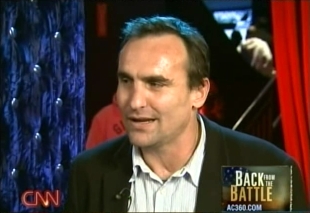
Length:
3:16
LARGE (38.0 MB) -----
SMALL (3.9 MB)
ANDERSON
COOPER: And Michael Ware joins us now. It's rare that
you're able to actually follow someone from the
battlefield and then hook up with them again. I mean,
as a reporter that's a great thing to be able to
follow up that long.
MICHAEL WARE: It is, like you say, it's something
unique. And after what some of us went through in
that battle, like many others, there's a bond that is
established.
COOPER: That battle was an extraordinary battle. I
mean, it was unlike any the U.S. has seen in many,
many, many years.
WARE: In so many ways, it's the defining battle of
the Iraq war. Now, the Iraq war is many conflicts,
many firefights. I mean, soldiers getting shot at all
the time. But in terms of two forces, opposing each
other, street-to-street -- and, I mean, not just
house-to-house, but room-to-room, the battle of
Fallujah was it. Otherwise, it's hit-and-run guerilla
combat. And in that battle is where David and I met
and we are still friends today.
COOPER: What did David do?
WARE: In that battle, something that David did to
save the lives of the 20-odd men he was with earned
him a nomination for America's highest award, the
Medal of Honor. When al-Qaeda fighters lured his
platoon into the house -- and we were with them --
they ambushed his men six feet away. And eventually,
the platoon was pushed outside. It was David who went
back inside and singlehandedly killed six al-Qaeda
fighters, sometimes hand-to-hand.
COOPER: Does he seem different now than when you met
him in -- obviously, it's a different situation.
WARE: Anderson, everybody is different. I mean,
that's the thing. Whether you are nominated for the
Medal of Honor, or whether you never leave the wire
of your forward operating base, once you've been in
that stuff, it stays with you forever. And I mean, I
remember one vet wrote when he came home that once
certain dark chambers of the heart are opened, they
can never be closed again. So, David is not the same
man he was when he went to war. None of us ever will
be.
COOPER: I mean, everybody has their own war,
everybody sees their own slice of the war, one
soldier once said to me. But there is a commonality
of experience. I mean, the bond that people share.
WARE: I mean, there really is a brotherhood, a
fraternity. Now, you know, that can be overplayed and
that can be devalued, the way people throw that word
around. But in combat, that's what these kids are
fighting for. There's a nobler cause, they're wearing
the flag on their sleeve but at the end of the day,
Anderson, it's you fighting for me and me fighting
for you. I want to make sure you get home and I'm
watching your back, and I know you, my brother, are
doing the exact same thing.
COOPER: And that's what a lot of the vets here
tonight are saying they want to see for the vets who
are returning home, that same sense of us looking out
for them and them looking out for us, and people
looking out for each other.
WARE: And it's a very hard thing, because no matter
how much people try back home, unless they've been
there, there's going to be a distance. People cannot
understand. And in fact, many of these veterans hope
that their loved ones never do understand. They don't
want their loved ones going through what they've been
through.
So, whilst that's a thing that protects their loved
ones, it's also the thing that forever will keep a
certain distance. So, it's just about hoping that
people can come to understand and find a way for
these guys to eventually make their way home, because
home is never the same again, Anderson.
COOPER: It's nice to have you back home as well,
Michael Ware, you've been in Iraq a long, long time.
WARE: My pleasure. Thank you.
COOPER: Thanks for staying with it. Appreciate
it.